Novel continuity checker
The entire book, checked at once.
A novel continuity checker reads a whole manuscript against a record of what is true in your story and reports where the book contradicts itself. In Loreon that record is your story bible, and the check is manuscript validation: a full sweep of every chapter, run when you ask for it.
It reads every chapter at once — the reading no human editor can hold in one pass, and no chat window can hold at all. For the scene you are writing right now, that is a different instrument.
The mechanism
Findings, not rewrites.
A validation run produces findings, each anchored to the passages it cites. A finding names its severity and category, quotes what clashed, and waits: you resolve it or dismiss it, and nothing in your manuscript changes without you. Editorial authority stays where it belongs.
- Every finding cites its passages. Chapter and paragraph — you read the evidence, not just the claim.
- Resolve or dismiss. Findings are a to-do list you control, not edits done to you.
- Run it when it matters. Before a revision pass, before your editor sees it, before book two locks book one's canon.
Mira arrives before she departs
Ch. 1 places her on the Long Quay two days after midwinter — her customs deposition has her leaving Vellhark four days after it.
§ ch. 1 ¶3 · ch. 9 ¶14The eleventh crate is never opened
Signed for with weight in ch. 3 — "lighter than air and heavier than the rest together" — then absent from the volume.
§ ch. 3 ¶4 · unresolvedFindings from a validation run: severity, category, the cited passages, and the decision left to you.
What it detects
Six ways a long book contradicts itself.
A continuity error is any place your manuscript states something that cannot be true alongside something else it states. They fall into six kinds, and a check that only catches one of them is not much use on a novel.
Character facts
Physical details, names, ages, ranks, relationships — established one way in chapter four and another way in chapter thirty-one. The most common kind, and the easiest to introduce during revision.
Timelines
Events that cannot happen in the order the book puts them in, durations that do not add up, seasons that move backwards, a journey that takes two days here and a week there.
Information flow — who knows what, and when
A character acting on something nobody has told them yet, or forgetting something they learned two chapters ago. The hardest kind to catch by rereading, because the error is in what a scene assumes rather than in anything it says.
World rules
Magic, technology, law, geography, custom — behaving one way where the rule is established and another way where the plot needs it to. Canon holds the rule; the sweep reads your prose against it.
Voice drift
A character's register, vocabulary or idiom shifting with nothing in the story to explain it. Not a contradiction of fact, but a contradiction of person.
Unresolved threads
Setups planted and never paid off — the promise the book makes and does not keep. A dropped foreshadow is not a mistake in a sentence but a mistake across a hundred thousand words, which is why it survives so many read-throughs.
A finding in full
Two passages, eight chapters apart.
A finding is only useful if you can check it. Each one quotes both sides of the clash and says where they live, so you are reading the evidence rather than trusting a verdict.
Chapter one · ¶3
They had come ashore at first light, two days after midwinter, when the Long Quay was still grey and the customs sheds unopened.
Chapter nine · ¶14
"I left Vellhark four days after midwinter," she said, "and I have not set foot there since."
Mira arrives before she departs
Ch. 1 puts her on the Long Quay two days after midwinter. Her deposition in ch. 9 has her leaving Vellhark four days after it — two days after she is already ashore.
§ ch. 1 ¶3 · ch. 9 ¶14One finding, both passages cited. You read the two lines and decide — the check does not.
What it will get wrong
Some findings are meant to be dismissed.
A continuity check reads what the manuscript says. It cannot read what you intended, so some of what it flags is your own craft working exactly as designed.
- Characters lie. A deposition that contradicts chapter one may be a timeline error or a witness perjuring herself. The check sees the same clash either way.
- Narrators mislead. An unreliable narrator contradicts the book on purpose, and every such contradiction is a finding you dismiss.
- Some setups pay off later. A thread flagged as dropped in volume one may be waiting for volume three.
- Canon has to exist. The sweep reads your prose against your story bible; a thin bible gives it little to check against.
- It is not a copyeditor. Continuity is not grammar, line editing or house style — and validation does not judge whether the story works. That is still a developmental editor's read, and a human's.
In the studio
The validation workspace, on a real project.
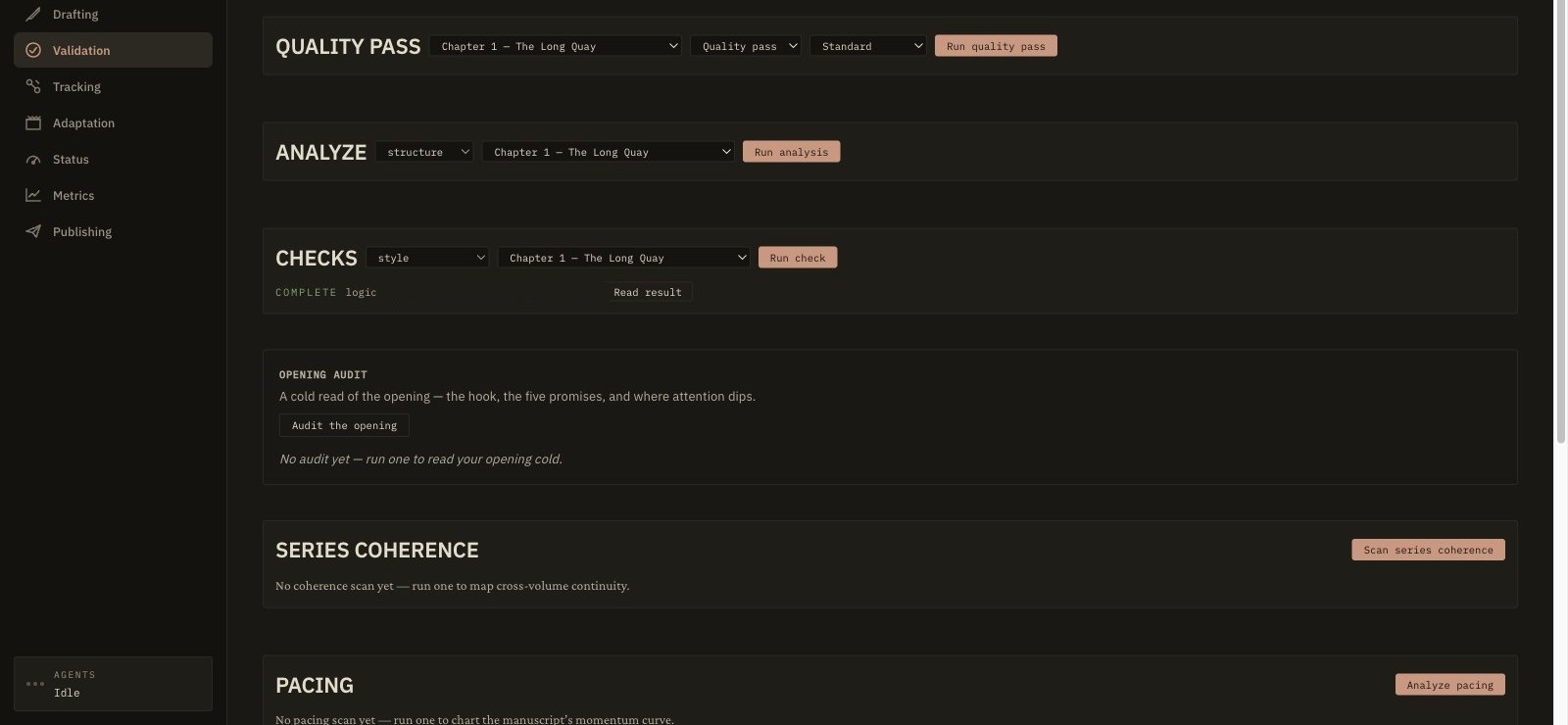
The validation workspace on a working manuscript: the suite of checks you run against canon — a quality pass, structural analysis, per-chapter checks, an opening audit, series coherence, and pacing — with a completed logic check on chapter one.
Common questions
Running validation.
How is this different from the consistency check?
Scale and moment. The per-scene consistency check reads the scene you are writing, when you ask. Validation reads every chapter at once — the instrument for revision time rather than drafting time.
How big a manuscript can it read?
The whole thing. An imported manuscript is capped at 150 chapters, 800 scenes and 50,000 paragraphs, with any single paragraph capped at 64 KiB — generous headroom for even a long multi-volume series. A validation run reads every chapter in the book, not a sample of it.
What does a run cost?
Validation is metered in prepaid credits — one cent per credit. Every run estimates its cost before you start, at most the estimate is reserved, and your balance never goes below zero. See pricing.
Will it rewrite anything?
No. Validation reads and reports. Each finding cites its passages; you resolve or dismiss; nothing changes without you.
The bottom line
Fresh eyes on a hundred thousand words.
Rereading your own book for contradictions is archaeology with a deadline. Validation does the sweep against a structured story bible and hands you the findings — and for a series, cross-volume coherence extends the same discipline across volumes. For the manual pass, see how to maintain continuity in a novel how to find plot holes, the continuity checklist, and how to find timeline errors. If a revision letter is what brought you here, see Loreon for manuscript revision. For the mechanism rather than the pitch, see continuity findings worked through end to end, and a real validation run, with what the author decided.
Loreon · The Writing Studio
Try it on your own manuscript.
The editor is free, and welcome credits cover your first real agent work — no subscription, no card on file.