Built with Loreon
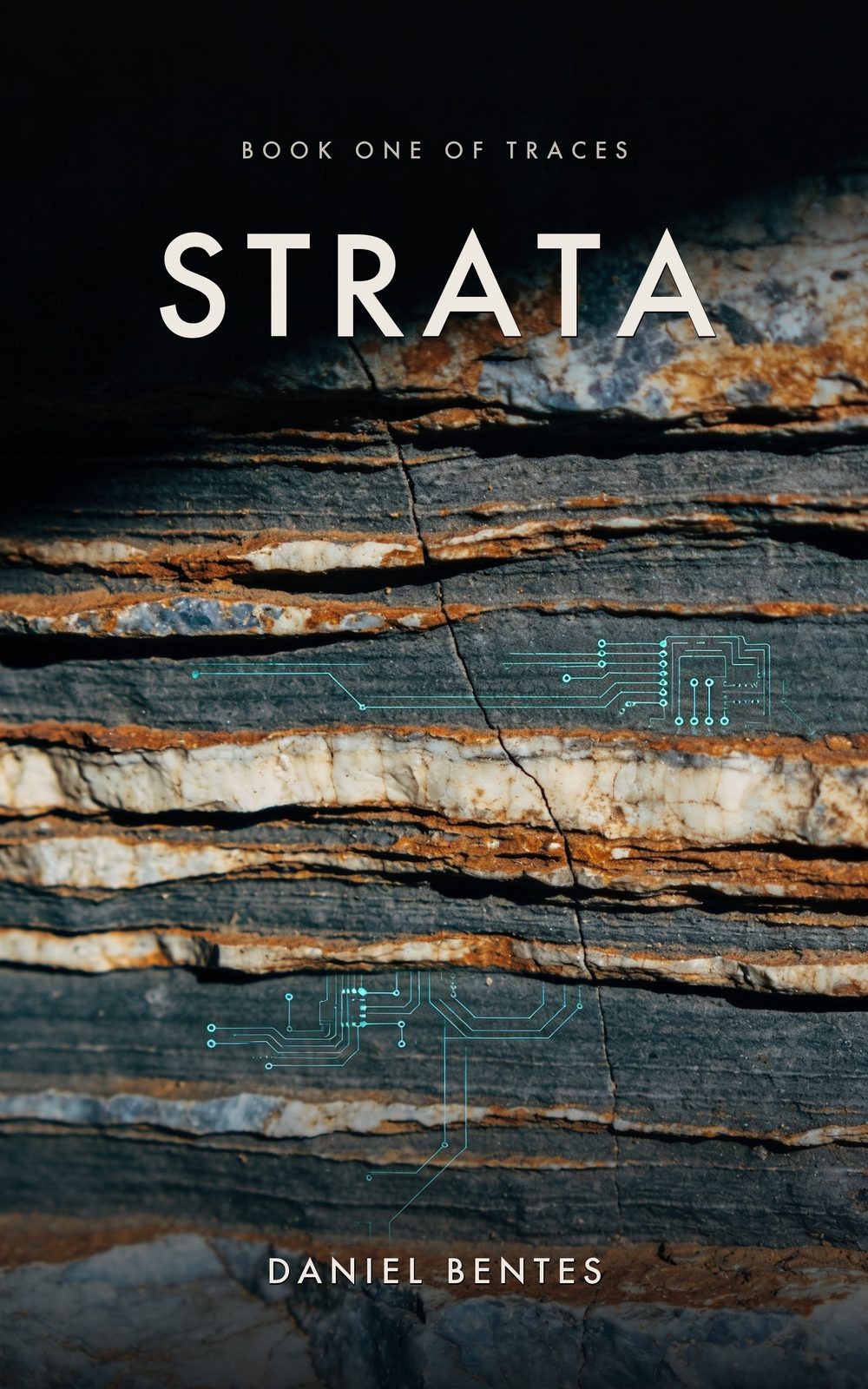
Strata
The first novel built with Loreon — and an honest account of how it was made.
The claim, answered
No purist stance about who holds the pen.
Loreon's home page makes a promise: that the interesting question is not whether a machine touched the manuscript, but whether the work is any good and whether anyone was home for it. Strata is the proof — a 170,000-word novel, human-originated and human-directed, whose prose was AI-drafted inside the framework and then revised by the author across more passes than he cares to count. This page says that plainly, because the book's own copyright page and afterword already do.
What the book is
Reality is a record, and it's being edited.
"You're misremembering."
Samuel Cole remembers a neighbor no one else on earth remembers. He is not wrong — the world is a record, and something very far ahead of us is editing it. When he finally looks straight at it, he finds the rule beneath everything: the record erases what it notices, and nothing makes a person more noticeable than being loved. Which puts his sister on the list.
Strata is available now from Loreon Press. Read the full description and buy it here →
A taste
The opening.
She would remember the sound of his laugh for forty-six years, long after everyone else had forgotten he existed.
That autumn afternoon, the laugh rang out from his room at the end of the hall. Sudden, surprised, delighted by something in the notebook spread across his knees. Chiyo stopped outside his door, caught by the sound. Kenji's laugh had always been like that: it arrived without warning and left you warmer than before.
— from the Prologue, "The Last Brother." Read on at loreon.press/strata.
How it was made
The honest account.
Strata was written with artificial intelligence — not as a gimmick, not as a shortcut, and not quietly. The prose was drafted by large language models working under the author's direction, inside the system that became Loreon, and then edited, cut, argued with, and rewritten across many passes. The plain word for that is AI-generated. The book says so on its own copyright page rather than leaving a reader to find out. What follows is the longer, truer description.
The story came first
The machine did not decide that reality is a record being edited, or that the Mandela Effect would be the last evidence that someone you loved was ever real. It did not decide the cosmology, the factions, the timeline, the thematic architecture, the arc of every character, or the shape of the ending. Those came out of years of reading and thinking and a great many bad ideas discarded before the good ones surfaced. The story existed before a single word of prose was generated — as a bible: a hundred documents of world, character, plot, theme, and rule, kept as structured canon the prose is checked against.
A room of specialists
The framework is not one general-purpose assistant. It is a roster of specialists, each with its own methodology: a worldbuilder, a voice keeper, a consistency keeper, a foreshadow keeper, a plot doctor. Each chapter was drafted against a scene card that specified what had to happen, whose point of view carried it, what the reader must feel, and what had to be true by the end of it. The draft that came back was raw material. Then the work started.
The whole manuscript, checked
What a long novel actually needs — and what a lone writer struggles to do — is remember. The framework tracks canon across 170,000 words and flags the moment chapter thirty-one contradicts chapter six. It audits the timeline. It knows what each character knows and when they learned it, and it catches the moment someone references a fact they have not yet been told. It watches for voice drift, and it hunts for the tics and tells of machine prose and makes you kill them. It reads like a hostile editor and reports what it finds — and then a human being has to decide what to do about it, because that decision is the job.
What went wrong
Some chapters survived largely as drafted. Many were rewritten to the studs. A few were thrown out and rebuilt from nothing, because the machine had produced something competent and correct and completely dead, and the only cure for that is a person who can feel it. The world does not need more competent, correct, dead prose. The interesting question is never whether a machine touched the manuscript. It is whether anyone was home — whether there is a person in here with something to say, who made a thousand choices you cannot see, and who is accountable for the result.
The author's own account is longer and less flattering than a studio would write, which is the point. The full afterword ships at the back of the book, where a reader finds it whether the author wanted them to or not.
Not a claim — a receipt
Show, don't tell.
Everything above is a claim you would be right to distrust. So here are the actual artifacts, pulled straight from the book's working repository: the world it was built on, the brief a chapter was drafted against, and what the validators caught. None of it is reconstructed for the website.
01-bible/                        99 markdown documents

  world/           44   cosmology, geography, the physics and social order
                        of the setting, deep-time history, two rival
                        cultures, and 11 real-world locations — Giza,
                        Barabar, Chavín de Huántar, Göbekli Tepe, the
                        Serapeum, Vredefort crater, Zealandia, Hessdalen…
  plot/            27   act structure, throughlines, tension and pacing
                        maps, and 13 scene-by-scene sequence specs
  characters/       9   one dossier per character: history, wound, voice,
                        want, and what they know when
  style/            8   voice, registers, dialogue, sensory and subtext
                        rules, and the anti-template config
  market/           6   comps, positioning, reader profiles
  organizations/    3   the factions, and who runs them
  themes/           2   the core question, the theme web
The afterword calls it "a hundred documents." The exact count today is 99 — kept as structured canon the prose is continuously checked against. It existed before a single sentence was drafted.
seq-01 · Opening Fracture
Prologue — "The Last Brother"          target: 2,500–4,000 words

  POV        Chiyo Moritani, age 12
  Setting    Kyoto, Japan — late autumn 1979
  Register   Standard, rising to High at the moment of correction

  What must happen, beat by beat
    P.1   Kenji shows Chiyo his notebook. Establish the bond: real,
          warm, specific. Plant the notebook as physical evidence.
    P.2   The wrongness begins. Reality destabilizes — sensory
          wrongness, an absence of sound. Dread without explanation.
    P.3   The Correction. Instant erasure; no violence, just absence.
          The most devastating beat. Do NOT explain the mechanics.
    P.4   Morning after. The parents do not remember him. The
          mother's "Who?" Chiyo, alone, with impossible grief.
This is the brief the drafter was given for the Prologue excerpted above — what happens, whose eyes we are behind, and, above all, what the reader must feel. The prose was written toward it, then revised against everything else in the bible.
timeline-auditor · day-grid precision audit
scope: post-Day-22 chapters, after a +7-day "Barabar" insert

  Method — walk every chapter in reading order; extract each temporal
  marker (weekday, "X days ago", elapsed duration, the five named
  clocks, datelines); compare against the day-grid and three fixed
  anchors: Day 1 = Mon Oct 27, Day 17 = Wed Nov 12, Day 22 = Mon Nov 17.

  Verdict
    BLOCKER   0
    HIGH      1    ch-29 still says "three weeks" — a stale marker from
                   before the insert; after the +7 shift it must read four
    MEDIUM    5    a deciding-span, "nearly a month", stray YAML day
                   fields, one dateline, "a month away"

  The +7-day shift is structurally sound. Both fixed anchors untouched.
One report of dozens. Add seven days to the timeline in the middle of a 170,000-word manuscript and a phrase four chapters later quietly goes wrong. A human skims past it; the auditor does not. A person still decides what to do about each flag — that decision is the job.
What went in before any of it · the research
The bible is the world of the book. Underneath it sits a second, separate body of work the framework never touches: the reading. Strata's deep-time premise is built on real places and real anomalies — the acoustic behavior of ancient stone chambers (the King's Chamber at Giza resonates near 117 hertz; the Barabar caves in India and Chavín de Huántar in the Andes are engineered for sound), the documented gatekeeping and still-unmapped voids under the Giza plateau, and the science of how memory and the felt sense of time can come apart. That research lives in the author's own notes, outside the bible — and it is why the strange parts of the book are load-bearing rather than decoration.
Next
Echoes — in preparation.
Strata is a complete story — it answers its own question and pays for the answer. Book Two of Traces, Echoes, is in preparation, where the framework's other thesis gets tested.