Features · Canon & continuity
Continuity kept while you write, not after.
The short answer: canon links appear in the margin as you type — write a name and it binds to its entry, no tagging. When you want the current scene read against canon, run a per-scene consistency check: it runs whenever you ask, reads that passage against the bible, and posts what it finds in the margin. Nothing runs behind your back, and nothing touches your prose.
The mechanism
Links bind; checks read.
Two separate instruments, deliberately separate. Linking is passive and free: names bind to canon entries as you type, so the bible is always one glance away. Checking is active and yours to invoke: a per-scene consistency check reads the scene you are in against canon and reports — it does not rewrite, and it does not run unasked.
- Canon links, as you type. A name binds to its entry the moment it lands on the page — no upkeep ritual.
- Checks, whenever you ask. The consistency check reads the current scene against canon on demand and posts findings to the margin.
- Findings, never edits. A finding cites what clashed; you decide what changes. Your prose is yours.
Chapter three · Ice in the Ledger Lines
The thaw came early and the ban came earlier. He signed for eleven crates he had not counted — Mira would have laughed at that — and the eleventh was lighter than air and heavier than the rest together.
The margin while drafting: a canon link bound as the name was typed, and a finding from an on-ask consistency check.
In the studio
The margin, on a real scene.
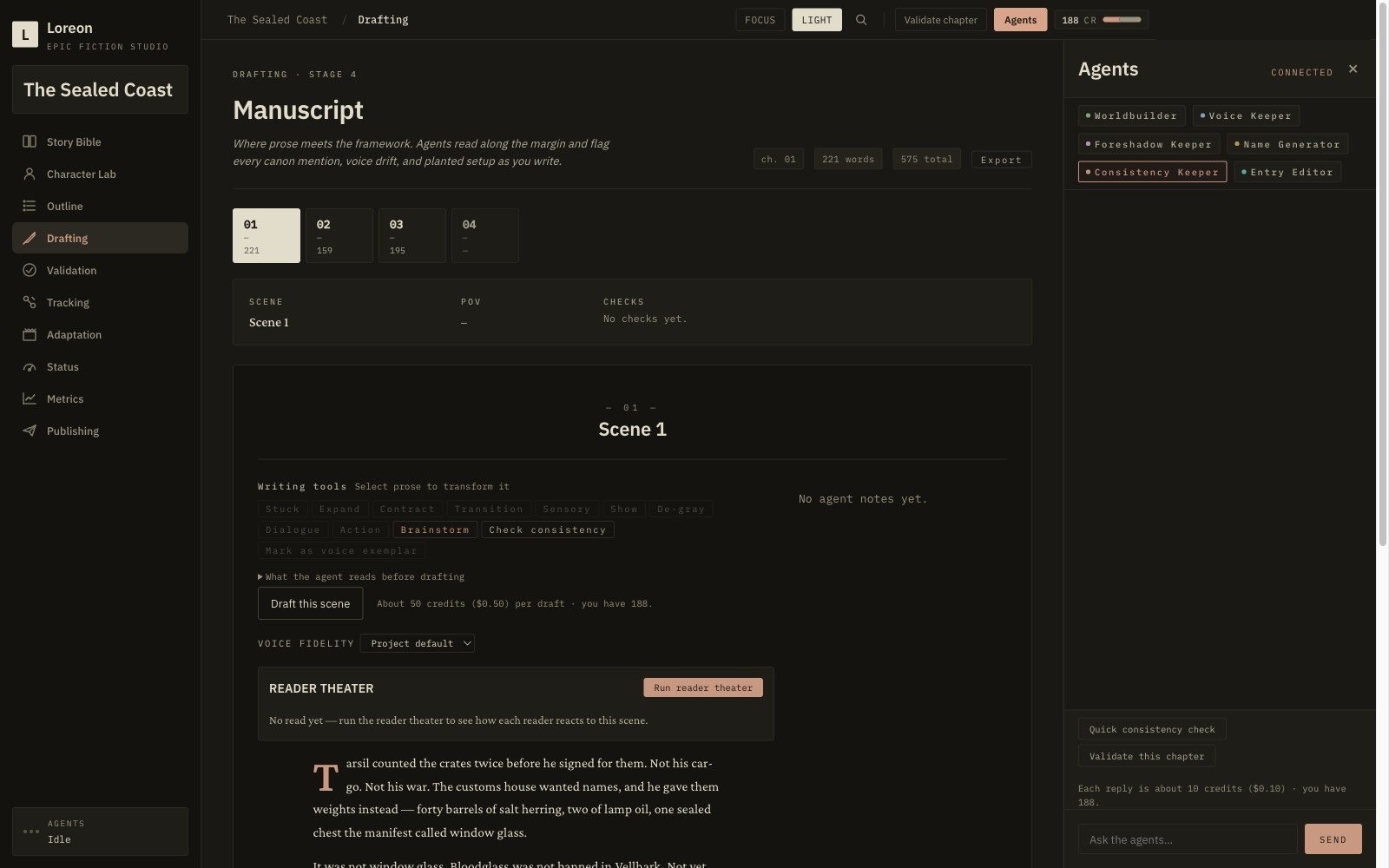
A working chapter open in the drafting editor, the agent panel with the Consistency Keeper connected, and the on-ask "Check consistency" control — the per-scene check reads the scene against canon the moment you ask, and the margin stays empty until it does.
Provenance
Entries cite their sources.
Canon is not a set of claims floating free of the book. When a check turns up a fact and you accept it into canon, the entry records the passages it came from — open the entry and read the exact lines that put it in the bible.
Grey wool cloaks on the quay. Funds the harbor guild without holding office in it.
- § vol. I, ch. 2 — "The Order funds the guild. Grey wool. You have seen the cloaks."
- § vol. I, ch. 3 — "The Order's grey wool was on the quay again."
An established entry: the passages that put this fact into canon, cited on the entry itself.
Common questions
How the check behaves.
Does it check the whole book while I type?
No — by design. The per-scene check reads the scene you are in, when you ask. For the whole book at once, run manuscript validation — a different instrument for a different moment.
What does a check cost?
Checks are metered in prepaid credits — one cent per credit — and every run estimates its cost before you start. Writing, linking, and reading canon are free; see pricing.
Can a finding change my text?
Never. Findings report and cite; you resolve or dismiss. Agents act only when you invoke them, and findings never touch your prose.
The bottom line
The margin remembers chapter three.
By chapter thirty, your memory of chapter three is a rumor. The margin's canon links and the on-ask consistency check are how Loreon keeps the book's own facts in reach while you write — grounded in a story bible the prose is checked against, and carried across a series by the cross-volume coherence check. For the method without any tool, see how to maintain continuity in a novel and how to track what each character knows. For the mechanism rather than the pitch, see how canon is built, linked and checked.
Loreon · The Writing Studio
Try it on your own manuscript.
The editor is free, and welcome credits cover your first real agent work — no subscription, no card on file.