Story bible software
A story bible your prose is checked against.
Story bible software holds everything that is true in your novel — characters, locations, cultures, the history and rules of your world — as structured records a program can read, rather than prose you have to reread. For a novelist that is the difference between notes you consult and canon that consults you.
In Loreon it is not a wiki you maintain on the side. It lives inside the project, cross-links as you type, and is what every consistency check and validation run reads your manuscript against.
The distinction
Three things a story bible is usually mistaken for.
Most writers already keep something called a story bible. Whether it earns its keep depends on what shape it is in.
- Not a document. A long file of everything you know about your world is a thing you reread, and past a certain length nobody rereads it. Structure is what lets software answer "what colour are her eyes in chapter four" without a human scrolling.
- Not a template. A blank form full of fields is a starting shape, not canon. Canon is what your book has actually established — which is why entries here cite the passages that put them there. See how to create a story bible for the manual version, template included.
- Not a standalone wiki. A wiki beside the manuscript can say one thing while chapter thirty says another, and nothing notices. A bible nothing checks against drifts by definition; the checking is the point.
What lives in it
Structured, not free-form.
Each kind of story fact is its own kind of entry, so the bible stays queryable instead of becoming one long document nobody rereads. A character carries facts, relationships, and voice; a substance carries rules; a faction carries reach and money. The structure is what lets software — not just you — read it.
- Characters, locations, cultures — and the history and rules of your world, each held as its own kind of entry.
- Cross-links surface as you type. Write a name and it binds to its canon entry — no tagging, no upkeep ritual.
- Canon, not commentary. Entries are the facts your prose is checked against, across chapters and volumes.
Courier on the northern routes into Vellhark. Left a sealed letter in Tarsil's keeping and vanished before the thaw.
A canon entity: one kind of entry among characters, locations, cultures, and the rules of the world.
In the studio
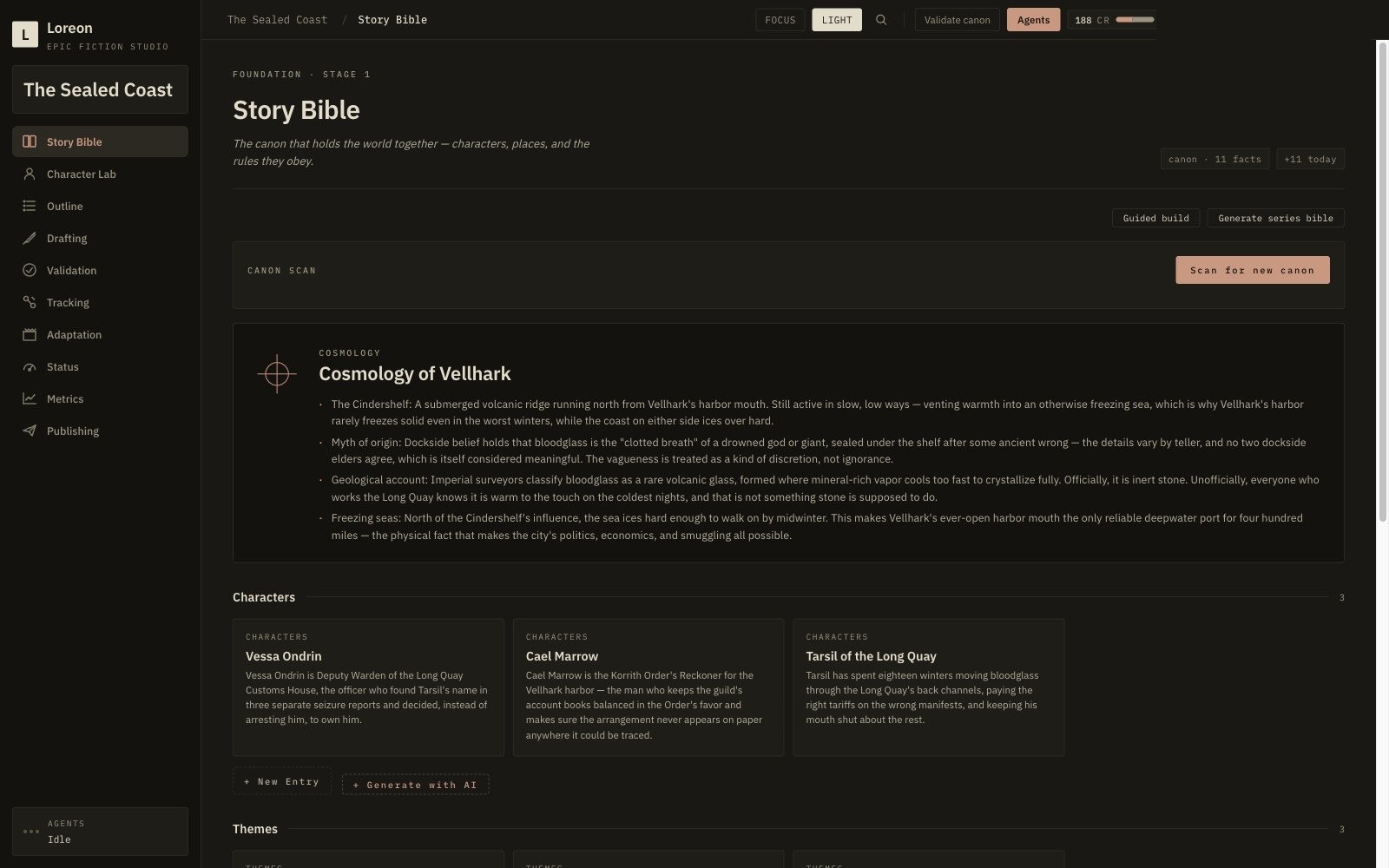
The bible, on a real project.
This is the story bible of a working two-volume project — structured entries the editor cross-links as you write, and the canon that validation reads the manuscript against.
Where entries come from
Built with you, grounded in the book.
Start from a premise and Loreon's writers' room generates a starter bible you shape from there — or import a manuscript you already have and grow canon out of the text itself. When a check turns up a fact and you accept it into canon, the entry records the passages it came from. The bible is grounded in the book, not in notes maintained beside it.
Common questions
Working with the bible.
Do I have to fill it in before I can write?
No. Generate a starter bible from a premise, import an existing draft, or begin with a handful of entries — the bible grows as the book does, and reading, writing, and editing are always free.
I already have a manuscript. Can it come in?
Yes — upload a .docx, .md, or .txt file, or paste your text, and Loreon splits it into chapters and scenes you can edit and validate.
What happens when my prose contradicts the bible?
That is the point of keeping canon structured: run a per-scene consistency check while you work, or validate the whole manuscript before a revision pass — findings cite their passages, and you resolve or dismiss them.
The bottom line
Canon that works for its keep.
A bible nobody checks is a wiki. Loreon's story bible earns its place because the software reads it: cross-links as you type, consistency checks on ask, and whole-manuscript validation on demand — and one bible holds a whole series, so a later volume writes against the same canon. See pricing — the editor and the bible itself are free; credits meter only the agent work. New to the idea? How to create a story bible and how to keep characters consistent walk through the whole method by hand. For the mechanism rather than the pitch, see the mechanism behind a structured bible.
Loreon · The Writing Studio
Try it on your own manuscript.
The editor is free, and welcome credits cover your first real agent work — no subscription, no card on file.